Oltrepò Pavese, less than 50 km south of Milan, is that slender piece of Lombardy that both separates and connects Piedmont
and Emilia-Romagna. A borderland since the Middle Ages, it is the original result of the meeting of four provinces that
converge around this grape-cluster-shaped territory: Pavia, Alessandria, Genoa and Piacenza.
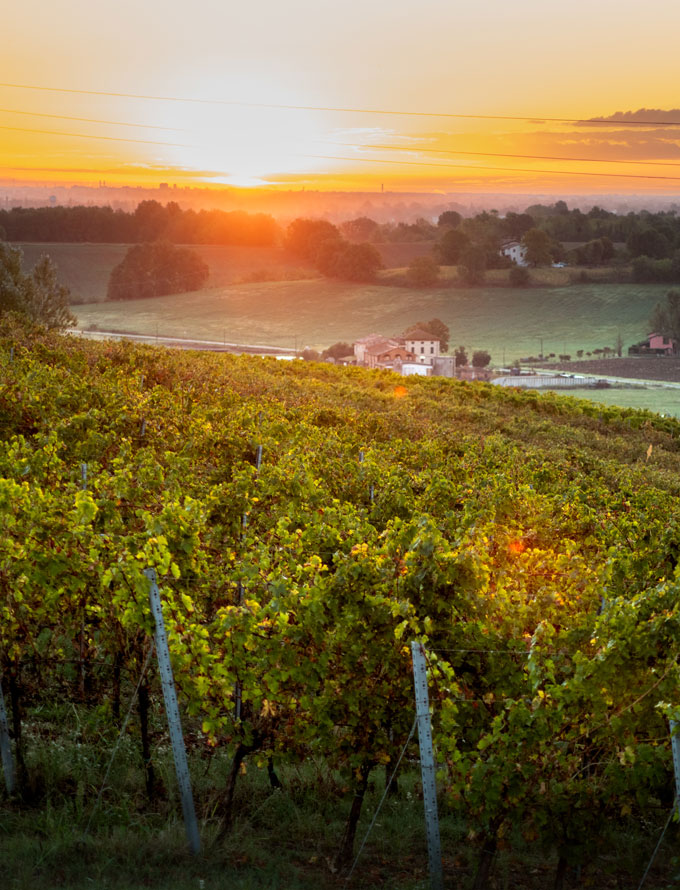
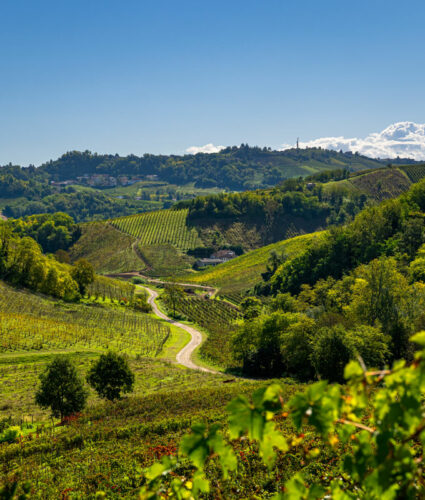
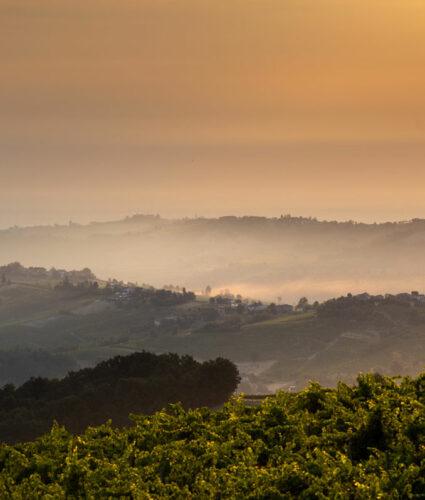
The territory extends from the Po plain to the peaks of the Apennines, up to the 1,724 metres of Monte Lesima, creating a landscape of hills and mountains, sometimes rugged, that has always been home to viticulture.
The wine zone follows the 45th parallel and gathers in four main valleys in the north-eastern part of the area: the Versa Valley, Scuropasso Valley, Coppa Valley and Staffora Valley.
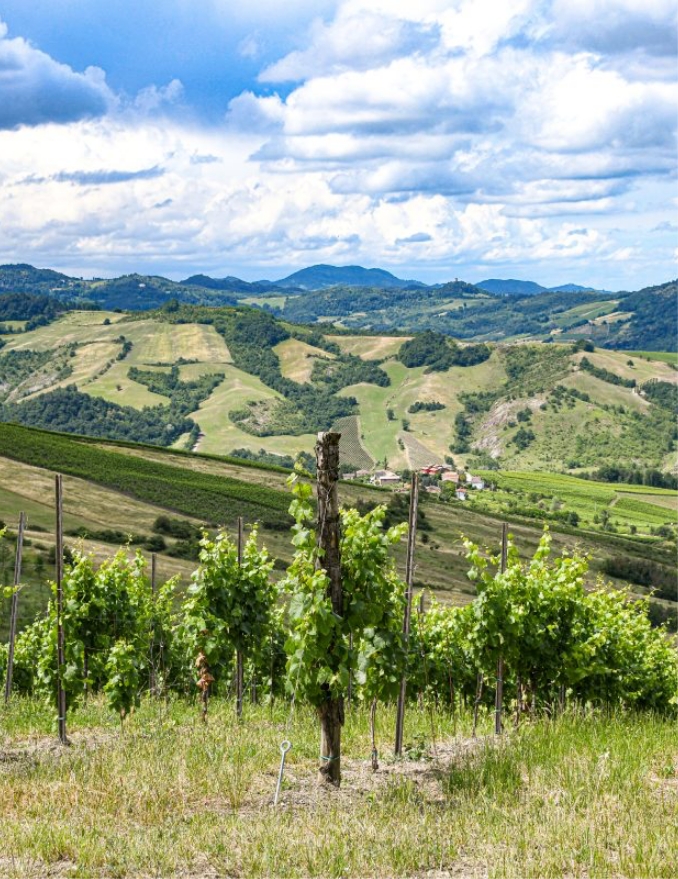
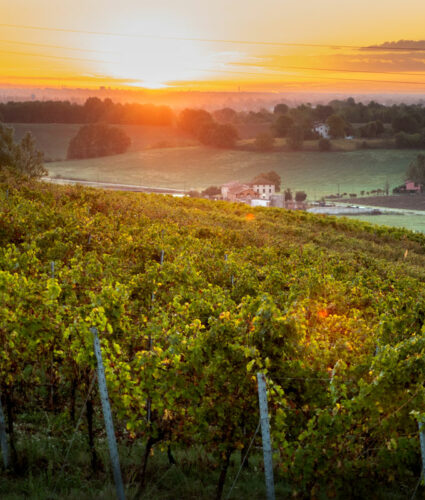
The alternation of fields, woods and vineyards ensures exceptional ecological variety: Oltrepò wine is born in a landscape that preserves biodiversity, where endemic species survive thanks also to numerous protected natural areas.
The vineyards lie at elevations ranging from 120 to 550 metres above sea level, occasionally reaching 600 or even 700 metres. Slopes are often very steep, frequently reaching 30%, a visible sign of the land’s dramatic and determined character.
It is on these hillsides climbing the Apennines that Classese is born, the Metodo Classico blanc de noirs from Pinot Noir, along with the other six denominations of Oltrepò Pavese wines.
MEAN VINEYARD ALTITUDE (M)
MUNICIPALITIES


The wine-growing area covered by the DOCG and DOC designations comprises the entire municipal territories of:
– Borgo Priolo;
– Borgoratto Mormorolo;
– Bosnasco;
– Calvignano;
– Canneto Pavese;
– Castana;
– Cecima;
– Godiasco Salice Terme;
– Golferenzo;
– Montalto Pavese;
– Montecalvo Versiggia;
– Montescano;
– Montù Beccaria;
– Mornico Losana;
– Oliva Gessi;
– Pietra de’ Giorgi;
– Rocca de’ Giorgi;
– Rocca Susella;
– Rovescala;
– San Damiano al Colle;
– Santa Maria della Versa;
– Torrazza Coste;
– Volpara;
– Zenevredo.
This area also extends into parts of the following municipalities:
– Broni;
– Casteggio;
– Cigognola;
– Codevilla;
– Colli Verdi, specifically the hamlets of Canevino and Ruino, which were previously separate municipalities whose entire territories fell within the DOCG and DOC wine-growing area;
– Corvino San Quirico;
– Fortunago;
– Montebello della Battaglia;
– Montesegale;
– Ponte Nizza;
– Redavalle;
– Retorbido;
– Rivanazzano Terme;
– Santa Giuletta;
– Stradella;
– Torricella Verzate.

The easternmost valley of Oltrepò Pavese is shaped by the Versa stream, whose springs are in Moncasacco, in the municipality of Alta Val Tidone, just beyond the provincial border. After a short stretch, where it marks the boundary between Alta Val Tidone and Colli Verdi, the stream enters the province of Pavia and flows down toward the plain as far as Stradella. The southern part, at higher altitudes, shows widespread badlands, while the northern slopes are gentler and more regular. Elevations rise above 600 metres above sea level. The valley’s main centres are Colli Verdi, Volpara, Montecalvo Versiggia, Golferenzo, Santa Maria della Versa, Montù Beccaria, Montescano, Castana, Canneto Pavese and Stradella.

The central valley of Oltrepò Pavese is crossed by the Scuropasso stream and its smaller tributaries. Its springs are near Pometo, in the municipality of Colli Verdi. The stream descends rapidly through a narrow, deep valley with steep slopes, passing Rocca de’ Giorgi, Montecalvo Versiggia, Montalto Pavese, Canneto Pavese, Pietra de’ Giorgi, Cigognola and Broni, before reaching the plain and flowing into the Po. The upper valley is marked by pronounced relief, while the area toward Broni has gentler slopes. The main centres include all the municipalities mentioned above, highlighting the wide variety of landscapes along the stream’s course.

Shaped by two main branches, the valley is crossed by the Coppa stream, whose springs are in Fortunago, and by the Ghiaie del Coppa, also known as Ghiaie dei Risi, which rises between Montalto Pavese and Colli Verdi. The two watercourses join at Borgo Priolo, from where the stream continues toward the plain as far as Casteggio, before flowing into the Po. The relief is moderate and gentle, with no great elevations. The main centres of the valley include Fortunago, Colli Verdi, Montalto Pavese, Borgoratto Mormorolo, Borgo Priolo, Calvignano, Montebello della Battaglia and Casteggio; nearby are also Torrazza Coste, Rocca Susella, Corvino San Quirico, Torricella Verzate, Mornico Losana, Oliva Gessi and Santa Giuletta, reflecting the valley’s network of small settlements.

The widest valley in Oltrepò Pavese is crossed by the Staffora stream, which rises at 1,343 metres at the Fontana di San Giacomo, near Passo del Giovà, in the municipality of Santa Margherita di Staffora. The stream initially runs through a mountain setting, surrounded by Apennine peaks including Monte Chiappo, Cima Colletta and Monte Boglelio. After Varzi and Bagnaria, the altitude decreases and the valley opens onto the hills and the plain in front of Voghera. The cultivated areas and main centres of the valley include Cecima, Ponte Nizza, Montesegale, Rocca Susella, Godiasco Salice Terme, Rivanazzano Terme, Retorbido, Codevilla and Torrazza Coste, the main reference points along the stream’s entire course.
The province of Pavia is a crossroads of historic and cultural routes of great value. Among them, Oltrepò Pavese sees the passage of the Via degli Abati, the Via di San Colombano and one of the many branches of the Via Francigena, whose standard route crosses the Po just beyond, but which historically passed widely through Oltrepò, as shown by the journeys of French pilgrims such as Saint Roch and Saint Bovo. The most important route for Oltrepò Pavese, however, is the Via del Sale, the path that connected the Duchy of Milan with the Ligurian Sea, whose main itinerary ran through the Staffora Valley before crossing the Apennines and heading toward Genoa, Camogli and Portofino. Along the Via del Sale, salt and ancient fruits were traded in abundance, and together with wine production and commerce this made Oltrepò Pavese a major hub for medieval trade and beyond, right into the modern era.